

Metal Recovery Trial to Production: Handover Questions
What should happen between a metal recovery trial and process integration?
A metal recovery trial to production handover should distinguish what the trial demonstrated, which conditions it represented and what remains to be confirmed at the proposed site. Agree responsibilities, integration assumptions, the next review and the required records before treating a trial result as a production commitment. A sample assessment is useful evidence; it is not a promise that every future feedstock or operating condition will behave identically.
The decision after a trial is rarely just whether a result looks encouraging. An operator also needs to understand what the result applies to, what the project includes and who is responsible for the next stage. Without that distinction, a technical discussion can quietly become an assumed promise about a complete operating line.
PolyGO describes itself as a chemistry and systems vendor, with the customer’s operation running the technology. This guide concerns the review and handover between evaluation and a proposed integration project. It does not provide chemical operating instructions, establish compatibility or prescribe a recovery process.
Keep the trial conclusion with its conditions
Ask for the conclusion to be connected to the material assessed and the scope of the work performed. Preserve the sample identification and the explanation of what the result represents. If the supplied information is unclear, raise the question before turning a summary into an internal investment or procurement assumption.
PolyGO’s waste evaluation service describes sample characterisation, a bench-scale trial and a recommendation. Those are related outputs, but they should remain identifiable. A report of material content, a trial observation and an estimated project outcome do not become the same fact because they appear in one proposal.
Also record the limits described by the technical provider. If an assumption was made about the feedstock or proposed application, keep it visible in the decision record. An unanswered question should remain an open item rather than being removed when the proposal is summarised for another team.
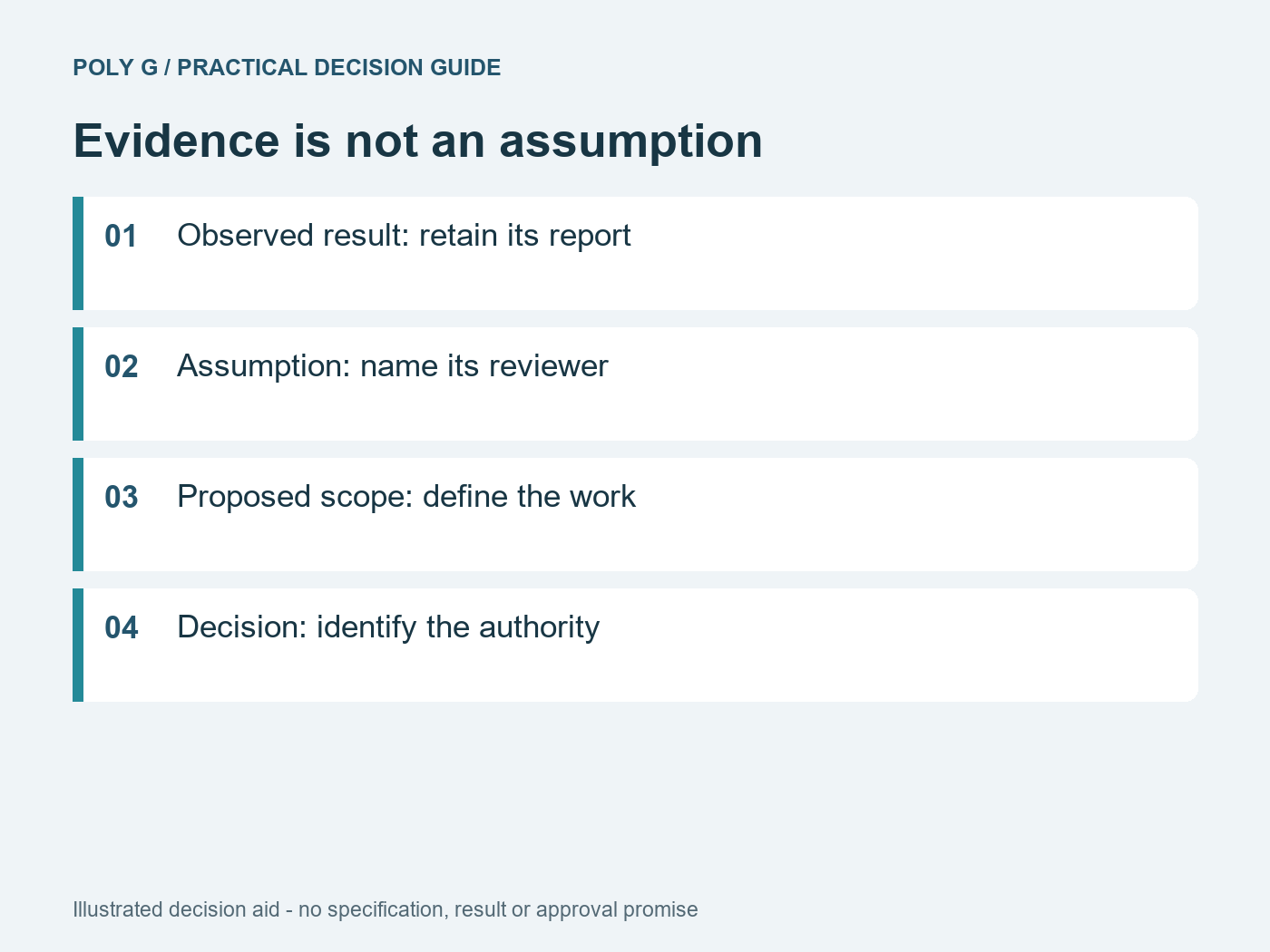
Separate evidence, assumptions and decisions
| Information type | Example of what to establish | How to use it |
|---|---|---|
| Observed trial evidence | Which assessed material and work the result refers to. | Keep the result with the supporting report. |
| Project assumption | What is assumed about the intended feed or site arrangement. | Identify who will confirm it and when. |
| Proposed scope | The supply, consultation or integration work included. | Compare it with what the operator actually needs. |
| Next-stage decision | What review or acceptance permits the project to proceed. | Name the responsible person and required evidence. |
This distinction is useful when the technical reviewer, procurement team and operations team read different summaries. All three should be able to find the same original conclusion and understand which later decision it supports.
Describe the proposed site integration separately
A laboratory or bench-scale assessment does not describe every part of the eventual installation. Ask which site information is required and which interfaces need review by the responsible technical parties. The purpose is to identify work and dependencies, not to select operating parameters from an article.
PolyGO’s project management service lists feasibility validation, procurement coordination, contractor scheduling, site integration and handover documentation. Confirm which of those activities are included in the particular engagement and which are provided by the operator or another contractor.
Where the project depends on an existing system, record the relevant interface questions for the appropriate reviewer. Do not let a general description such as “fits the line” replace an accepted scope explaining what will be supplied, connected, reviewed and handed over.
Make responsibility visible at each stage
Name the party responsible for the technical recommendation, the procurement decision, the site work and operational acceptance. A coordinator can bring the parties together without assuming every responsibility that appears on the project schedule.
PolyGO explicitly distinguishes its technical project management from full engineering, procurement and construction contracting. Its service description says that full EPC work is typically executed with a partner. Do not convert a project-management engagement into an assumption that one supplier accepts every site or contractor obligation.
If a responsibility is shared, write down the handover between the parties. For example, establish who provides information for a review, who evaluates it and who can accept the proposed next step. These are project questions to resolve in the engagement, rather than standard contract terms imposed by this guide.
Review changes in material or objectives
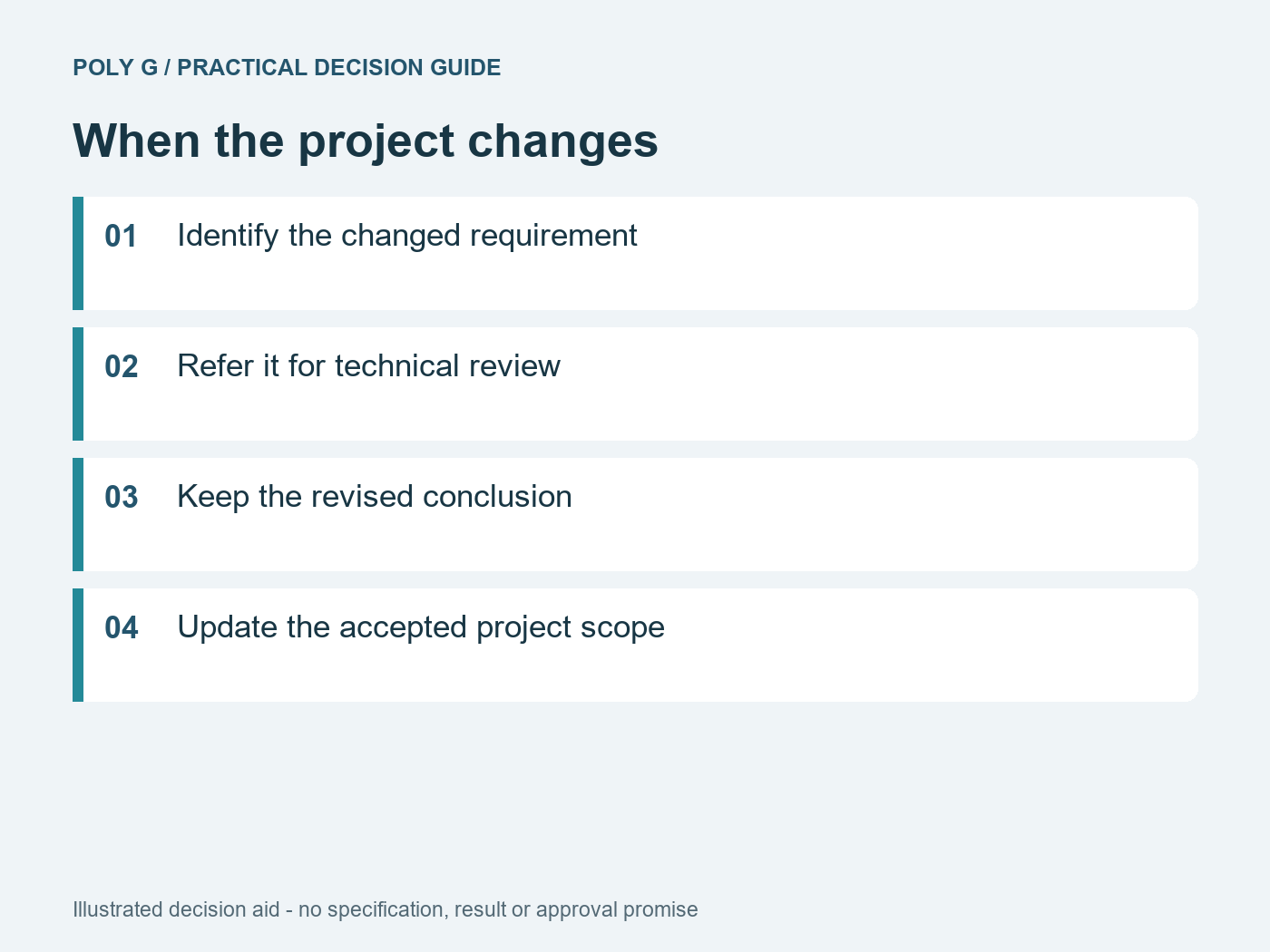
If the intended feedstock, target outcome or site arrangement changes after evaluation, identify the change to the technical provider. The project team should not decide on its own that an earlier result applies to a new situation.
PolyGO’s technical consultation service covers selection guidance, characterisation review and troubleshooting. Confirm the scope of any further review instead of treating continuing advice as automatically included in the original sample assessment.
The same discipline applies when a commercial objective changes. A project initially reviewed for one outcome may be summarised internally in terms of another. Preserve the original basis and seek a revised assessment where needed; do not present a new target as an already demonstrated result.
Define what a useful handover should contain
Before proceeding, agree the records and explanations needed by the next team. These may include the accepted scope, the relevant technical conclusions, integration decisions, responsibilities, open items and the next review. The exact requirements depend on the engagement and the operator’s process.
Check that each open item has an owner and a clear question. “Confirm site interface with the responsible engineer” is more useful than a general note to “check installation”. Keep the response with the accepted version of the project documents.
A useful handover makes uncertainty manageable. It does not remove uncertainty by promising a recovery result, production rate, environmental outcome or return on investment that has not been established for the proposed operation.
Trial-to-integration questions
Does a successful sample trial guarantee production performance?
No such conclusion should be assumed. Establish the material and conditions the trial represented, its stated limits and the further review needed for the proposed operation.
Is project management the same as a complete EPC contract?
No. Confirm the responsibilities in the actual engagement. PolyGO’s published project-management scope distinguishes technical coordination from full EPC contracting.
What if the feedstock changes after the trial?
Identify the change to the technical provider and ask whether further assessment is required. Do not silently apply the old conclusion to the changed material.
Who decides that the project can move to the next stage?
The engagement and the operator’s authorised process should identify the responsible decision maker and the evidence they need. A general article cannot provide that approval.