
Silver Stripping for Plated Scrap: Routes and Recovery
In industry, silver stripping means dissolving the silver plating off connectors, contacts, lead frames, busbars and production rejects so the silver can be recovered and, often, the copper or brass underneath reclaimed. It is not the same as removing tarnish from silverware. The main routes are acid stripping, cyanide stripping, proprietary cyanide-free strippers and electrolytic stripping, and they differ most in how hard they are on the substrate, how safe they are to run and how easily the silver comes back out of solution. This guide compares them for electronics, plating and recycling operations in Singapore and Malaysia, and covers the step most explanations leave out: getting the silver back.
In short
- Stripping removes the silver layer itself; tarnish removal only cleans the surface of solid silver.
- Plated scrap is worth stripping when there is enough silver per kilogram and the substrate is worth keeping intact.
- Acid, cyanide, cyanide-free and electrolytic routes trade speed against substrate attack, safety and paperwork.
- Protecting copper and brass comes down to the formulation, water and oxidiser control, temperature and pulling parts on time.
- Silver is recovered from the loaded stripper by cementation, chloride precipitation, electrowinning or selective resin.
Silver stripping vs tarnish removal
Search for silver stripping and you will find dips, cloths and baking-soda tricks. Those deal with tarnish, the thin dark silver sulfide film on cutlery and jewellery. The goal there is to keep every bit of silver and remove only the discolouration.
Industrial silver stripping does the opposite. The goal is to remove the whole silver layer, as completely and selectively as possible, from a base metal that is usually copper, brass or a copper alloy, sometimes over a nickel underlayer. The stripped parts may be re-plated, sold as clean copper scrap or scrapped. The silver ends up in solution or as a solid, and that is where its value is.
Which plated scrap is worth stripping
Silver-plated material turns up across electronics and electrical manufacturing:
- connectors, terminals and switch contacts;
- lead frames and other stamped electronic parts;
- silver-plated copper busbars and switchgear components;
- plating rejects and off-cuts from in-house lines;
- decorative and mirror coatings.
PolyGO’s silver recovery chemistry page lists silver-plated industrial scrap, electronic-contact silver, decorative and mirror coatings and end-of-life photovoltaic panels as typical feedstocks. Its e-waste applications page covers the wider picture for PCBs, connectors and lead frames.
Whether a lot is worth stripping depends on a few things you can check before you buy any chemistry:
| Factor | Favours stripping | Works against it |
|---|---|---|
| Silver per kilogram of scrap | Thick plating, high surface area per kilogram | Thin flash on heavy parts |
| Substrate value | Clean copper or brass that sells better once stripped | Low-value or mixed substrate |
| Other coatings | Silver directly on copper | Gold, tin or solder on top, or a nickel layer complicating chemistry |
| Consistency | Steady supply of one part type | Mixed lots that need sorting |
| Contamination | Clean parts | Oil, plastic housings, potting compounds |
A sample assay settles most of these questions. XRF gives a quick reading of what is on the surface, and ICP gives a precise silver content for valuation.
Main silver stripping routes: acid, cyanide, cyanide-free and electrolytic
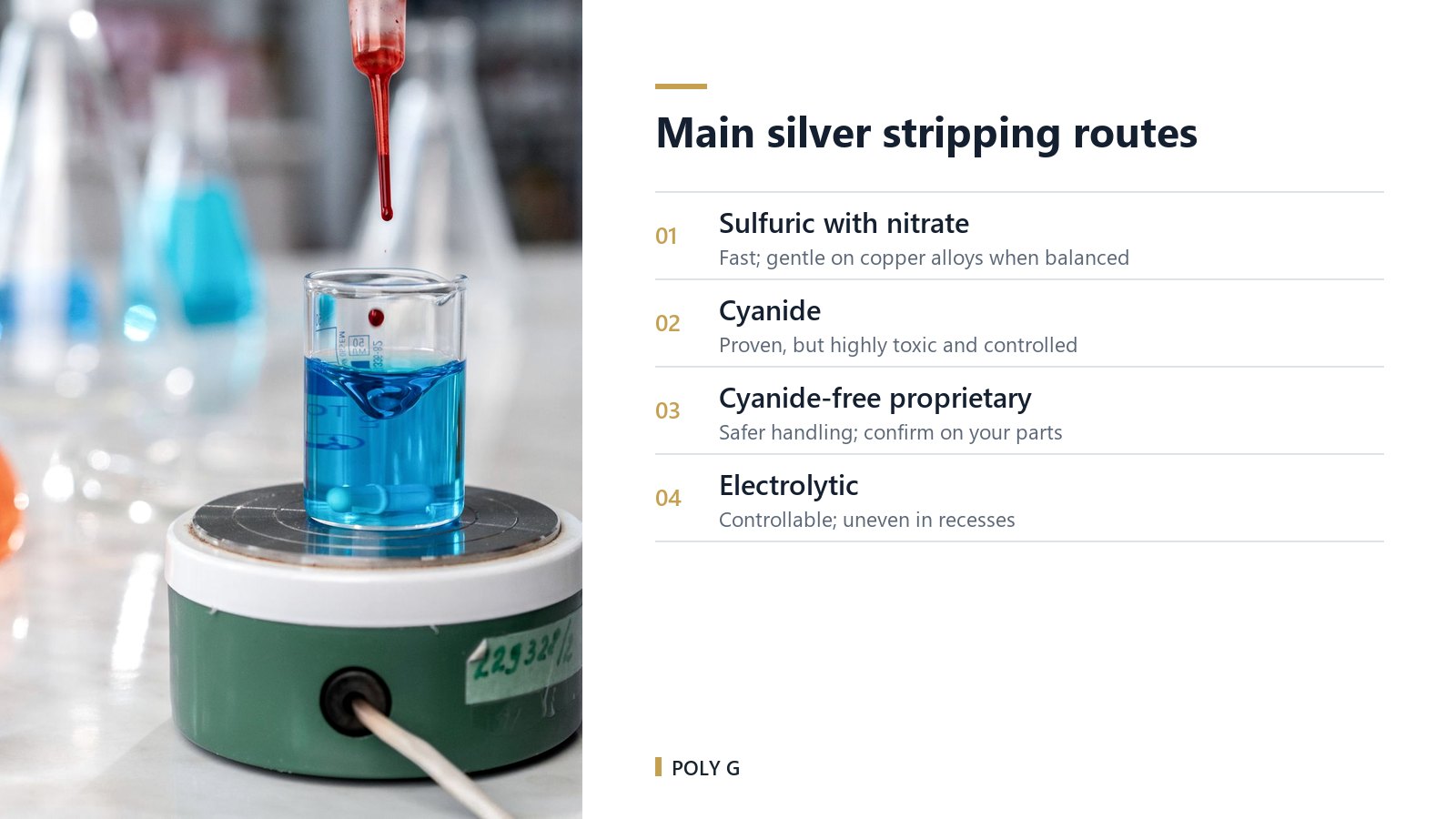
Acid stripping. The classic acid route uses strong, concentrated sulfuric acid with a small amount of nitric acid or nitrate as the oxidiser. In concentrated acid the base metal tends to passivate, so the silver dissolves while copper and brass are largely left alone. The balance is delicate. A patent on selective noble-metal removal describes keeping nitrate low and water content low, and notes that too much nitrate can cause overheating and rapid dissolution of the base metal (US 11,136,681, Greene Lyon Group).
Cyanide stripping. Cyanide solutions, usually with an oxidiser or applied current, dissolve silver well and have a long history in plating shops. The price is the hazard: cyanide needs strict handling, segregated waste and treatment before any discharge.
Cyanide-free proprietary strippers. Several suppliers now offer immersion strippers that work without cyanide and are formulated to leave copper and brass intact. PolyGO’s silver stripping chemistry is one of these: a non-cyanide stripper that, according to the company, recovers silver in solid form directly from scrap, electronic feedstock and decorative components.
Electrolytic stripping. The part is made the anode in a suitable electrolyte and current takes the silver off. It gives good control of the end point but needs rectifiers and racking, and complex shapes may strip unevenly.
| Route | Strengths | Watch-outs |
|---|---|---|
| Sulfuric with nitrate | Fast, low-cost reagents, gentle on copper alloys when balanced | Concentrated acid, fumes, tight water and nitrate control |
| Cyanide | Proven, dissolves silver readily | Highly toxic, controlled chemical, strict waste handling |
| Cyanide-free proprietary | Safer handling, designed for substrate protection | Supplier-specific; confirm performance on your parts |
| Electrolytic | Controllable, can use milder electrolytes | Equipment, racking, uneven stripping in recesses |
Protecting the copper or brass substrate
Silver rarely clears evenly. Edges and thin areas are bare first, and from that moment the substrate is exposed to the solution. Substrate attack wastes chemistry, contaminates the loaded stripper with copper and zinc, and makes the silver harder to recover cleanly. A few habits keep it under control:
- Use a chemistry rated for the substrate, and test it on coupons of your actual parts.
- In acid systems, keep water out and keep oxidiser additions within the supplier’s or your own tested range.
- Control temperature. Hotter is faster, but it also speeds up base-metal attack.
- Load baskets so parts do not nest and shield each other, then pull them as soon as the silver has cleared.
- Track copper in the solution. A rising copper level is an early warning that parts are staying in too long or the bath is drifting.
Where a nickel underlayer sits between the silver and the copper, a stripper that is selective for silver may stop at the nickel. That can be useful, but plan what happens to the nickel-coated parts afterwards.
Recovering silver from the loaded stripper
Stripping only moves the silver off the parts. Until it is out of the solution as metal or a salt, nobody will pay you for it. The main options:
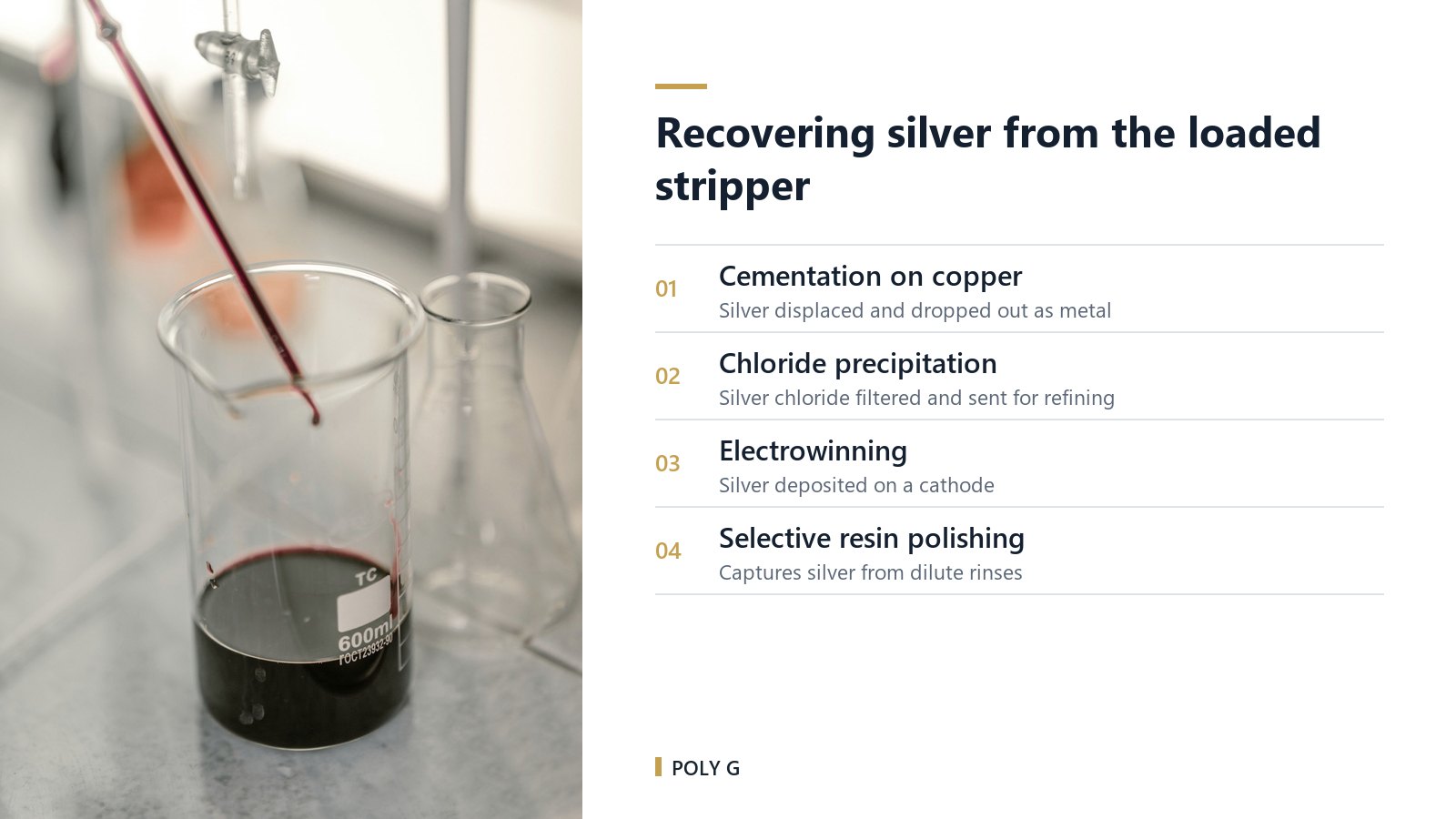
- Cementation on copper. Copper placed in a suitable silver solution displaces the silver, which drops out as metal. The patent cited above describes it as simple to implement with good selectivity for silver.
- Chloride precipitation. Adding chloride precipitates silver chloride, which is filtered and sent for refining.
- Electrowinning. Current deposits silver on a cathode, which suits steady volumes of loaded solution.
- Selective resin polishing. Dilute rinses and tail solutions can be passed through a resin that captures silver ions. PolyGO’s PolyGOResin cartridge is designed for gold, silver and platinum-group metal ions; PolyGO states that its silver process, paired with PolyGOResin capture, targets up to 98% silver recovery. That is the vendor’s own target, and real figures depend on the feedstock and line design.
Each option leaves a barren solution that still contains acid, copper and traces of silver. That residue goes to treatment, and PolyGO’s precipitation chemicals cover both jobs the page describes: recovering precious metals from liquid waste streams and heavy-metal treatment for compliant discharge.
Safety and waste handling in Singapore
Several silver stripping chemistries involve controlled chemicals. NEA’s list of controlled hazardous substances includes cyanides and nitric acid above 9%, and anyone importing, selling or exporting a controlled substance needs a Hazardous Substances Licence, with separate transport approval above prescribed quantities (NEA hazardous substances).
Spent strippers and their sludges are waste streams in their own right. NEA’s list of licensed toxic industrial waste collectors includes entries such as plating effluents and residues containing silver, stripping solutions containing precious metals and spent etchant containing cyanide and silver (NEA list of TIW collectors, August 2026). Use a collector licensed for the specific waste type.
For anything going to the public sewer, PUB’s published requirements set silver at 5 mg/L, cyanide at 2 mg/L and a combined metals total of 10 mg/L where two or more listed metals are present, and bar untreated toxic industrial waste (PUB trade effluent requirements). Under MOM’s guidance, introducing a new stripping chemistry is also a trigger to review your workplace risk assessment. Plants in Malaysia should check the Department of Environment’s Environmental Quality (Industrial Effluent) Regulations 2009 for their site.
In-house stripping or a refiner: how to decide
Not every generator should strip its own scrap. Sending plated material to a refiner is simpler, but you are paid on their assay, after their charges, and you give up the substrate value. Stripping in-house keeps more of the value but brings chemistry, labour, permits and waste handling with it.
In-house stripping tends to make sense when the same plated parts arrive steadily, the substrate is worth recovering clean, you already run chemical processes with trained staff and licensed waste collection, and the silver content justifies the set-up. A refiner or toll processor is usually the better choice for small, irregular or very mixed lots, or where the site has no chemical handling in place.
A middle path is common: strip in-house with a safer chemistry, recover silver to a solid or a concentrate, and sell that to a refiner. PolyGO describes itself as a chemistry and systems vendor rather than a recycler, so this is the model it supports. The operator runs the process, and PolyGO supplies the chemistry and the process recommendation.
Getting started
The most useful first step is a sample. PolyGO offers a sample assay to establish silver content and feedstock chemistry before recommending a stripping or leaching approach, with projected recovery economics. You can arrange this through the contact page.
Frequently asked questions
Can silver plating be removed without damaging copper?
Yes, with a chemistry designed for copper substrates and good process control. Balanced sulfuric-nitrate systems and several cyanide-free proprietary strippers are formulated to leave copper and brass largely intact. Test on your own parts and pull them promptly once the silver has cleared.
Is cyanide still used to strip silver?
Yes, some plants still use cyanide-based strippers because they work reliably. Cyanides are controlled hazardous substances in Singapore, and the waste needs careful handling, so many operators now prefer cyanide-free chemistry where it performs well enough on their parts.
How is silver recovered after stripping?
Common routes are cementation on copper, precipitation as silver chloride and electrowinning onto a cathode. Dilute rinses can be polished with a selective ion-exchange resin. The recovered silver is then sold to or refined by a precious metals refiner.
Is stripping silver from plated scrap worth it?
It depends on how much silver the scrap carries, whether the substrate is worth recovering and how steady the supply is. An assay of a representative sample, compared against what a refiner would pay for the scrap as it is, gives a clear answer.
Who regulates spent stripping solutions in Singapore?
NEA controls toxic industrial waste and hazardous substances, so spent strippers must go to a licensed toxic industrial waste collector. PUB sets the limits for anything discharged to the public sewer, and MOM’s workplace safety rules cover handling on site.