

Nickel Stripping: Methods, Bath Life and Nickel Recovery
Nickel stripping is the controlled removal of a nickel or electroless nickel coating from a part, so the part can be re-plated, repaired or reclaimed without damaging the metal underneath. On a production line it is done either by chemical immersion, where a stripper dissolves the nickel, or electrolytically, where current drives the nickel off the part. The right method depends mainly on the base metal and the type of nickel deposit. What most guides skip is the end of the process: a spent nickel stripper is a nickel-bearing liquid that has to be treated or, if the chemistry allows, recovered. This guide covers both halves for plating and finishing plants in Singapore and Malaysia.
In short
- Production lines strip nickel to rework rejected parts, refurbish worn components and clear plating racks and fixtures.
- Immersion stripping is simple and handles complex shapes; electrolytic stripping is faster to control and can use milder chemistry.
- Choose the stripper for the base metal first. A chemistry that is safe on steel can attack copper, brass or aluminium.
- High-phosphorus electroless nickel is harder to strip than low- or medium-phosphorus deposits.
- A bath is spent when strip rate falls and dissolved nickel builds up. At that point it is a regulated waste, and possibly a nickel source.
What nickel stripping is and when production lines need it
In a hobby workshop, stripping nickel usually means taking the shine off an old part. In a plating shop it is a routine production step with three common triggers.
- Rework of rejects. Parts that fail on adhesion, thickness, pitting or appearance are stripped back to the substrate and plated again. On high-value machined parts, stripping is far cheaper than scrapping.
- Refurbishment. Worn or damaged nickel or electroless nickel coatings on tooling, moulds, valves and shafts are removed before re-coating.
- Racks, jigs and fixtures. Plating racks pick up nickel every cycle and need stripping to keep contact points working.
In each case the job is the same: get all the nickel off, evenly, and leave the substrate dimensionally and cosmetically intact. Every choice below, from chemistry to bath life, comes back to that.
Chemical immersion vs electrolytic nickel stripping
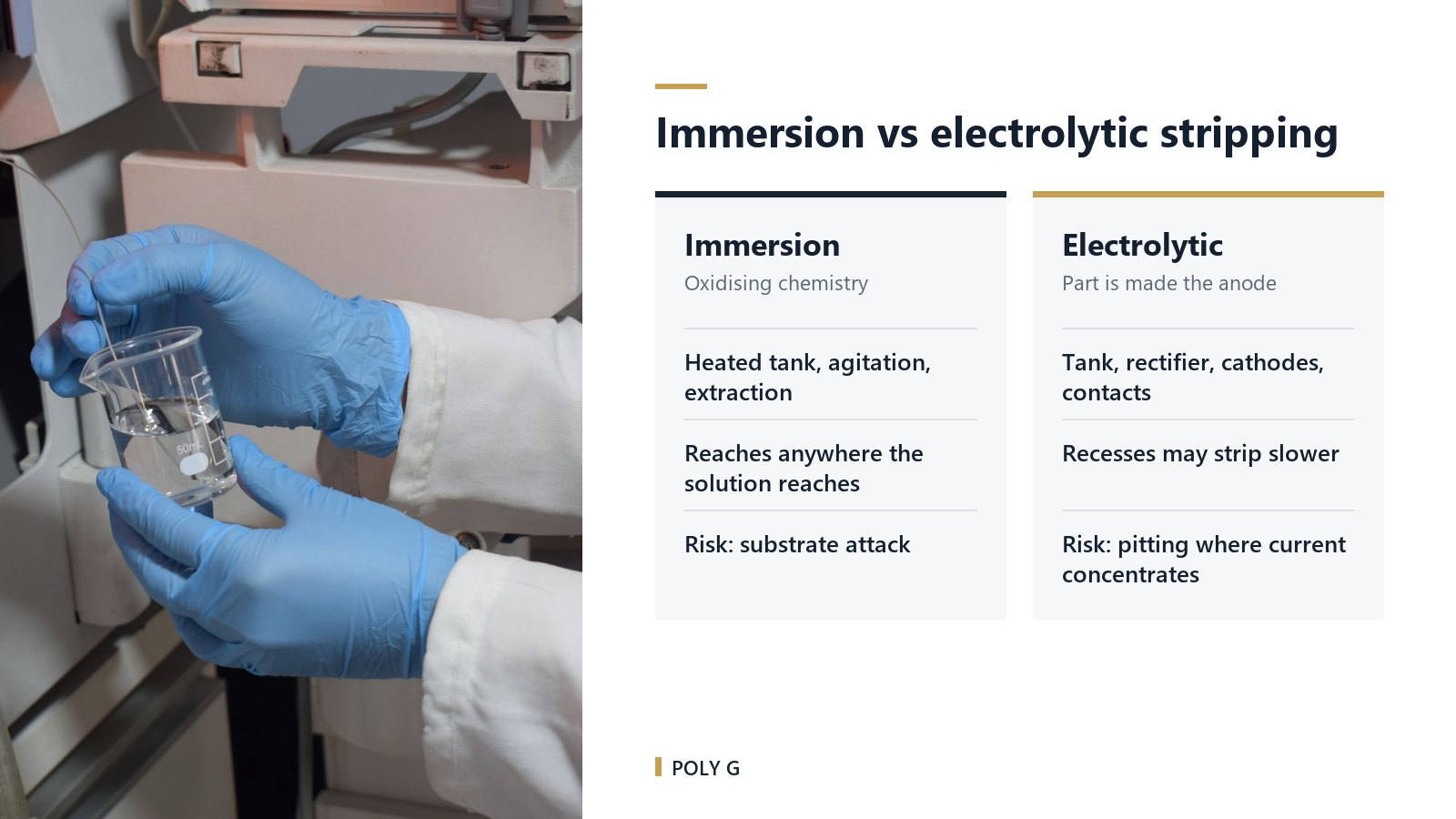
The two main routes differ in how the nickel is driven into solution.
| Factor | Chemical immersion | Electrolytic stripping |
|---|---|---|
| How it works | Oxidising chemistry dissolves nickel from the whole wetted surface | Part is made the anode; current drives nickel off |
| Equipment | Heated tank, agitation, extraction | Tank plus rectifier, cathodes and electrical contacts |
| Complex shapes and bores | Reaches anywhere the solution reaches | Recesses may strip slower than edges |
| Control of end point | Time, temperature and visual checks | Current and voltage behaviour give extra signals |
| Main risk | Substrate attack once nickel is gone | Pitting or etching where current concentrates |
Immersion strippers come in several families. Acid strippers are fast but are often aggressive to some substrates. Proprietary alkaline strippers built for steel rely on oxidisers with inhibitors that slow attack on the base metal once it is exposed. Electrolytic strippers can work with milder solutions, because the current does much of the work. PolyGO’s own nickel stripping chemistry is an electrolytic process, which the company describes as removing nickel plating with minimal substrate damage and without harsh chemical reagents.
Matching the stripper to the base metal
The first question is never “which stripper is strongest”. It is “what will this stripper do to the substrate once the nickel has gone?” Nickel rarely clears evenly. Thin areas and edges are bare long before thick areas and recesses, so the substrate spends time exposed to the solution whatever you do.
- Steel and stainless steel. The widest choice. Many commercial strippers are formulated for steel with inhibitors to protect it. Watch hardened and high-strength steels, which can be sensitive to some acid processes.
- Copper and brass. Much less forgiving. Oxidising acids that dissolve nickel will also dissolve copper alloys, so strippers sold for steel are often unsuitable. Confirm with the supplier that the chemistry is rated for copper-based substrates.
- Aluminium. Strongly alkaline and many acid solutions attack aluminium. It needs a chemistry specifically rated for it.
- Mixed assemblies. Parts with inserts, brazed joints or two base metals need a chemistry that is safe on the most vulnerable one.
Run test coupons of the actual substrate, with the actual coating, before committing a production batch. Measure weight loss or dimensions after a deliberate over-strip, because that tells you how much margin you have when a recess takes longer to clear. If the part also carries paint, powder coat or a tin layer that must come off first, that is a separate surface preparation step; PolyGO’s surface preparation and coatings removal range covers those layers.
Electroless nickel: why phosphorus content matters
Electroless nickel is a nickel-phosphorus alloy, and its phosphorus content changes how it strips. Low- and medium-phosphorus deposits generally strip faster. High-phosphorus deposits, which are chosen for corrosion resistance, are also more resistant to many strippers.
Manufacturers design specific products around this. Atotech, for example, describes its UniStrip HPN as a stripper for high-phosphorus nickel on steel that is also effective, and even faster, on low- and medium-phosphorus coatings (Atotech UniStrip HPN product page). Brand aside, the practical lesson is to know the phosphorus class of the deposit before you choose a stripper, and to check the supplier’s data for that class rather than a generic strip rate. If incoming parts come from several platers, ask each one for the deposit specification.
How to tell when a stripping bath is spent
A stripper does not fail suddenly. It slows down as the nickel it has dissolved builds up and the active chemistry is used. Suppliers usually rate bath life by dissolved nickel loading; the Atotech page above, for instance, quotes a bath life of over 20 g/l of nickel for that product. Your own supplier’s figure is the one to work to.
Signs that a bath is near the end:
- Strip time for a standard part keeps rising even at the correct temperature.
- Analysis shows dissolved nickel approaching the supplier’s limit.
- Parts start showing substrate etching, staining or pitting that did not appear before.
- Additions to restore activity are needed more often and have less effect.
- Sludge or crystals form in the tank.
A simple log of parts or square metres stripped per batch, strip time and dissolved nickel makes the end point predictable. It also gives you the data you need for the next decision: what to do with the spent solution.
What is in spent nickel stripper
By the time it is changed, a stripping bath holds a mix that reflects both the formulation and the parts it has processed:
- dissolved nickel, often the main metal by a wide margin;
- iron, copper or zinc from substrate attack;
- phosphorus compounds, where electroless nickel was stripped;
- remaining oxidisers, acids or alkalis;
- complexing agents or amines from the formulation, which hold nickel in solution.
Those complexing agents matter. They are part of why the stripper works, and they are also why nickel stays in solution when you raise the pH. A treatment plant that copes with ordinary rinse water can be thrown off by one batch of spent stripper dumped into the equalisation tank. Keep it separate and get it analysed.
Treating vs recovering the nickel
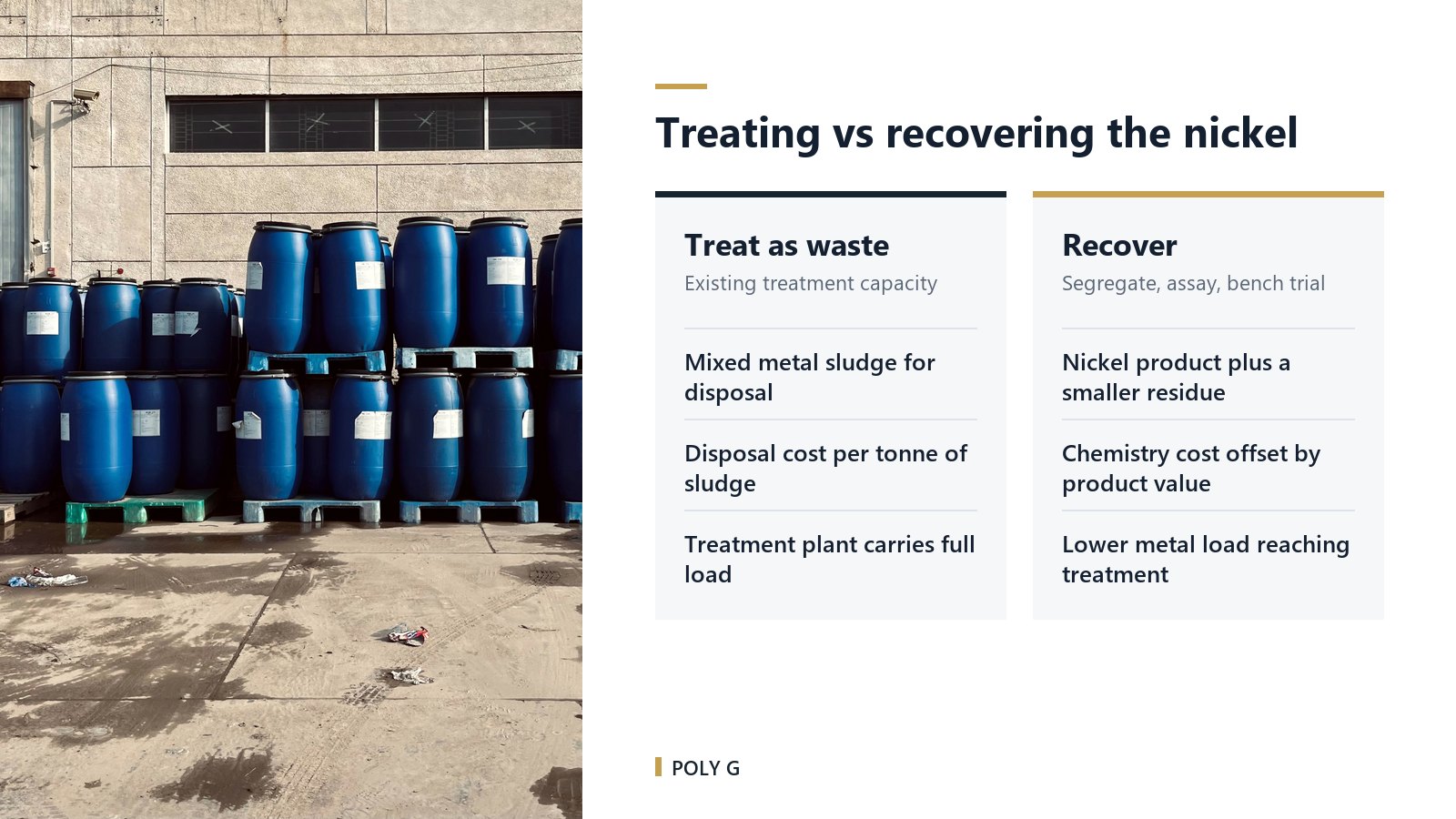
There are two ways to deal with a spent stripper. You can treat it as waste: break the complexes, precipitate the nickel with everything else and send the sludge to a licensed collector. Or, where the nickel concentration and the chemistry allow, you can recover the nickel as a product.
| Question | Treat as waste | Recover the nickel |
|---|---|---|
| Output | Mixed metal sludge for disposal | Nickel product for sale or refining, plus a smaller residue |
| Cost direction | Disposal cost per tonne of sludge | Chemistry cost offset by product value |
| Needs | Existing treatment capacity | Segregated stream, assay, bench trial |
| Effect on discharge | Treatment plant carries the full load | Lower metal load reaching treatment |
PolyGO’s nickel range includes a proprietary wastewater process that precipitates nickel as a high-purity powder intended for resale into refining or precursor manufacturing. The company positions it as a complement to an existing treatment plant, sitting at the metals-removal stage, not a replacement. Whether it suits a particular spent stripper depends on what the analysis shows, which is why a waste evaluation with XRF and ICP assay and a bench-scale trial comes first.
Singapore and Malaysia discharge and disposal points to check
Spent nickel stripper is not something to bleed into the sewer. In Singapore, PUB’s published requirements for trade effluent entering the public sewerage system set nickel at 10 mg/L, with a total of 10 mg/L where two or more listed metals are present, and pH between 6 and 9. Untreated toxic industrial waste must not be discharged at all (PUB requirements, last updated 18 September 2025). Our article on meeting Singapore effluent limits covers how plants reach those figures without slowing production.
Other points to check:
- Toxic industrial waste. NEA’s list of licensed collectors includes “plating effluents and residues containing nickel” and metal hydroxide sludges among the waste types they are licensed for. Spent stripper and its treatment sludge should go to a collector licensed for that waste.
- Hazardous substances. Some stripping chemicals are controlled. NEA’s list of controlled hazardous substances includes nitric acid above 9% and cyanides, and importing or selling a controlled substance needs a Hazardous Substances Licence (NEA hazardous substances). Check your supplier’s position and your own storage obligations.
- Risk assessment. MOM expects companies to review risk assessments at least every three years and whenever new substances or procedures are introduced (MOM FAQ). A new stripper chemistry is such a change.
- Malaysia. Plants in Malaysia discharge under the Department of Environment’s Environmental Quality (Industrial Effluent) Regulations 2009 and should check the applicable standard for their site.
Where to start
If your line strips nickel regularly, two questions are worth answering this quarter: is the stripping chemistry right for your substrates, and what is the spent bath actually worth? PolyGO can look at both. Its outsource chemist service covers chemistry selection and troubleshooting as a stand-alone engagement, and a sample of spent stripper can be assessed for nickel recovery. Get in touch through the contact page.
Frequently asked questions
Can nickel plating be stripped without damaging steel?
Yes, with a stripper formulated for steel and controlled time and temperature. Inhibited immersion strippers and electrolytic stripping are both used on steel. Test on coupons first and check for etching after a deliberate over-strip.
Is nitric acid safe for stripping nickel from steel?
Nitric acid is used in some stripping processes, but it is hazardous, fumes heavily and attacks copper and brass readily, so it is a poor choice for mixed or copper-based parts. In Singapore, nitric acid above 9% is on NEA’s list of controlled hazardous substances. Most production lines use proprietary strippers or electrolytic processes designed for the substrate.
How long does a nickel stripping bath last?
It depends on the chemistry and how much nickel it dissolves. Suppliers usually rate bath life by dissolved nickel loading, so track strip time and nickel content and change the bath at the supplier’s limit.
Can nickel be recovered from spent stripping solution?
Often, yes, if the stream is kept separate and the chemistry allows the nickel to be separated from complexing agents and other metals. Precipitation as a nickel powder is one route. An assay and bench trial on your own spent bath will show whether recovery is practical.
Does spent nickel stripper count as toxic industrial waste in Singapore?
Spent nickel-bearing plating and stripping solutions should be handled as toxic industrial waste. NEA’s list of licensed collectors includes plating effluents and residues containing nickel. Confirm the classification with your licensed collector and do not discharge untreated stripper to the sewer.