

Effluent Metal Recovery: When It Pays to Recover
Effluent metal recovery means pulling a metal out of a liquid waste stream as something you can sell or refine, instead of only converting it into sludge so the water passes discharge limits. It pays when a stream carries enough of a valuable metal, in a form that chemistry can separate, at a volume that adds up over a month. In most plating, refining and hydrometallurgy plants in Singapore and Malaysia, one or two segregated streams are worth recovering. The combined end-of-pipe flow rarely is. This guide covers how to tell the difference, how precipitation and selective resin compare, and what to test before you spend money on either.
In short
- Treatment and recovery are not rivals. Recovery takes value out of a stream; treatment still has to bring what is left within discharge limits.
- Look first at concentrated, segregated streams: spent baths, stripper solutions, drag-out rinses, leachate and bleed streams. Once they are mixed into the main effluent, the metal is diluted and mixed with everything else.
- An assay decides the route. You need the target metal concentration, daily volume, competing ions, pH and any complexing agents.
- Precipitation suits richer streams and gives a solid for refining. Selective ion-exchange resin suits dilute streams and polishing.
- Recovery does not remove the need for PUB’s written consent to discharge trade effluent, or NEA’s controls on toxic industrial waste.
Recovering metal vs treating to discharge
A conventional effluent plant treats dissolved metals as a problem to remove. It adjusts pH, adds a precipitant and flocculant, settles the solids and presses them into a cake that goes to a licensed collector. The water leaves compliant, and the metal leaves as a disposal cost.
Recovery asks a different question of the same stream: can the metal come out cleanly enough, and in enough quantity, to be sold, refined or reused? The output is a concentrate, a high-grade precipitate, a powder or a loaded resin, not a mixed sludge. A review of metal recovery from industrial wastes in Environmental Technology & Innovation put the economics bluntly: recovery only makes sense when its cost is well below the value of the metal (Krishnan et al., 2021, via the US EPA HERO database).
In practice the two sit in series. Recovery takes the bulk of the valuable metal out of a segregated stream, and the existing treatment plant handles the remainder. PolyGO describes its own nickel wastewater process the same way: it complements the treatment plant by slotting into the metals-removal stage rather than replacing it.
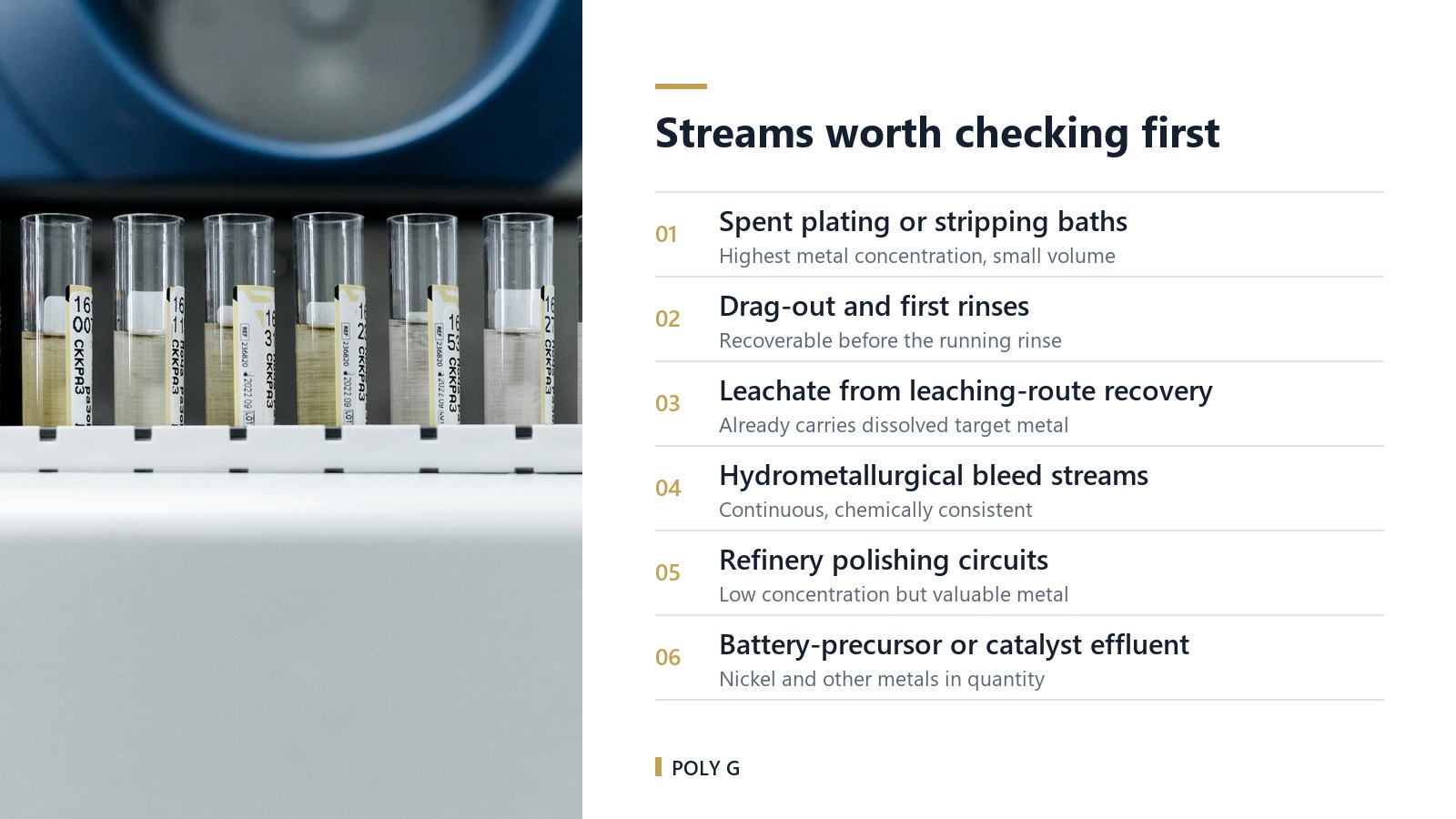
Streams worth checking first for effluent metal recovery
Where to look depends on where the metal is concentrated, not where the volume is. The final effluent pit has the most water and usually the least value per litre. Start upstream.
| Stream | Why it can be worth a look | Watch for |
|---|---|---|
| Spent plating or stripping baths | Highest metal concentration in the plant, small volume, batch discharge | Strong acids, oxidisers and complexing agents in the formulation |
| Drag-out and first rinses | Steady flow carrying bath chemistry; often recoverable before the running rinse dilutes it | Concentration varies with line speed and rack design |
| Leachate from leaching-route recovery | Already carries dissolved target metal; precipitation is the natural next step | Base metals leached alongside the precious metal |
| Hydrometallurgical bleed streams | Continuous, chemically consistent | High background of iron, copper or nickel |
| Refinery polishing circuits | Low concentration but valuable metal | Volumes large enough to need selective capture |
| Battery-precursor or catalyst plant effluent | Nickel and other metals in quantity | Ammonia or organic additives holding metal in solution |
Most of these match the feedstocks PolyGO lists on its precipitation chemicals and water treatment and nickel product pages: electroplating effluent and rinse water, leachate, hydrometallurgical bleed, refinery polishing circuits, and battery-precursor and catalyst plant effluent. Spent baths are added here because they are usually the richest liquid on site. Your plant may have others, such as etchant or catalyst wash water, and the same logic applies.
The single most useful step is segregation. A spent bath that goes straight into the equalisation tank is diluted many times over and mixed with every other metal on site. Once that happens, any recovery has to be more selective and handle far more water. Keeping one rich stream in its own tank or IBC is often the cheapest recovery decision a plant makes.
What an assay must show before you decide
Nobody can tell you a stream is worth recovering without numbers from that stream. A useful assay answers six questions:
- Target metal concentration, ideally from several samples across shifts or batches, because a single grab sample can mislead.
- Volume per day or per batch, so concentration can be turned into mass.
- Competing metals: copper, iron, nickel and zinc behind a precious metal change both the chemistry and the purity of the product.
- pH and free acid or alkali, which decide reagent consumption and which resins can survive the stream.
- Complexing agents such as cyanide, ammonia, EDTA or amines. They hold metals in solution and can defeat simple precipitation.
- Oxidisers, organics and suspended solids, which foul resin and contaminate precipitates.
The mass calculation itself is simple. As an illustration only, a rinse at 50 mg/L of a metal, flowing 2 m³ a day, carries 100 g of that metal a day. Whether 100 g a day is worth chasing depends entirely on which metal it is, how much the recovery chemistry costs per gram and what a refiner will pay for the product. That is why the assay and a bench trial come before any quotation.
PolyGO’s waste evaluation service uses XRF for a quick composition screen and ICP for precise metal content, then runs a bench-scale trial on the actual material. The page gives a typical turnaround of one to two weeks from receipt of the sample.
Chemical precipitation for recovery
Precipitation turns a dissolved metal into a solid that can be filtered off. In treatment, the aim is simply to get every metal out together. In recovery, the aim is a solid that is rich in the target metal and low in everything else, so a refiner will pay for it.
That difference drives the choice of chemistry:
- Bulk hydroxide precipitation by pH adjustment drops most base metals at once. It is the workhorse of compliance, but the mixed hydroxide sludge it produces rarely has resale value.
- Selective precipitation uses reagents that target a particular metal, or a staged pH sequence that drops metals one at a time. The product is cleaner and smaller in volume.
- Recovery as powder or metal is possible for some streams. PolyGO’s nickel page, for example, describes a proprietary process that precipitates nickel from wastewater as a high-purity powder.
PolyGO’s precipitation page sums up the trade-off: precipitation gives a high-grade solid output for refining, while resin gives selective capture at low concentration, and most lines use both. Precipitation works best on the richer streams in the table above. Complexing agents are its main enemy, so the assay result for cyanide, ammonia or chelators matters more here than anywhere else.
Selective ion-exchange resin for dilute streams
When a valuable metal is present at low concentration in a large volume of water, precipitating it is slow and reagent-hungry. Ion-exchange resin works the other way round: the stream passes through a bed or cartridge, and the resin holds on to the target ions while the water moves on. Capacity builds up on the resin until it is loaded, then the resin is eluted, regenerated or sent for refining.
General-purpose resins pick up whatever ions are most plentiful, which is usually the base metals you do not want. Selective resins are designed to favour particular metals against that background. PolyGO’s PolyGOResin is a cartridge-format resin targeted at gold, silver and platinum-group metal ions. PolyGO states a recovery rate of up to 98% and final purity of up to 95%, and lists its compatibility as 0 to 14 (read as the full pH scale). Those are the vendor’s own figures, not independent results. What you get depends on your stream, so confirm them in a trial. Our guide to choosing ion-exchange resin covers resin types and the questions to settle before a trial.
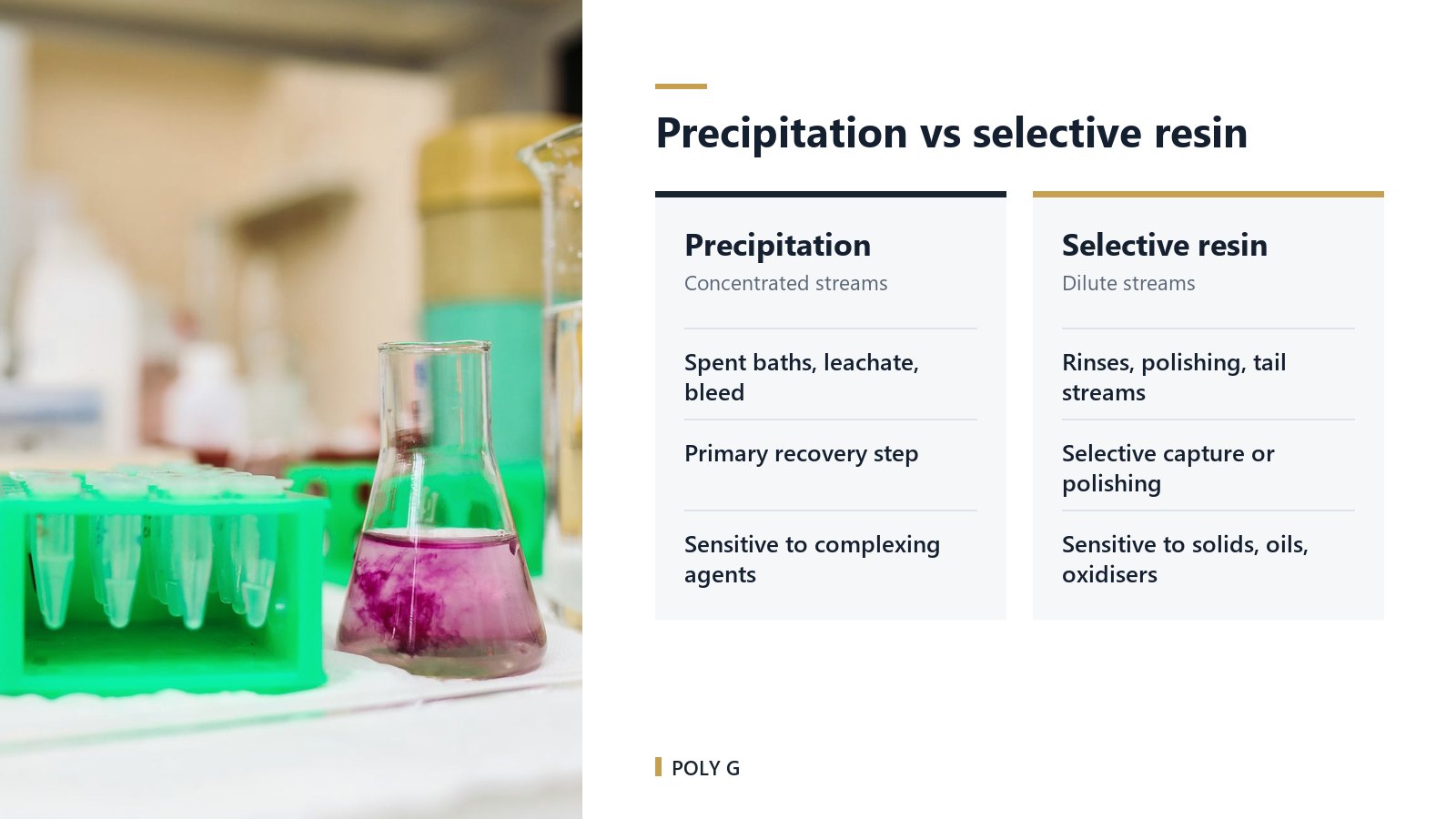
| Question | Chemical precipitation | Selective ion-exchange resin |
|---|---|---|
| Best-suited stream | Concentrated: spent baths, leachate, bleed | Dilute: rinses, polishing, tail streams |
| Product | Solid precipitate, powder or concentrate | Loaded resin, then eluate or resin to refiner |
| Main running cost | Reagents and solids handling | Resin, regeneration chemicals, replacement |
| Sensitive to | Complexing agents, mixed metals | Fouling by solids, oils and oxidisers |
| Typical role | Primary recovery step | Selective capture or polishing after precipitation |
What happens to sludge and loaded resin
Every recovery route leaves something behind, and in Singapore that residue is likely to be toxic industrial waste. NEA controls it under the Environmental Public Health (Toxic Industrial Waste) Regulations, and transport above the prescribed quantities is only approved for licensed toxic industrial waste collectors, with consignments tracked electronically (NEA toxic waste control FAQs). NEA’s list of licensed collectors includes waste types such as metal hydroxide and oxide sludges, plating effluents and residues containing specific metals, and spent catalysts and resins.
Recovery changes this picture in two ways. A selective step should leave less metal in the final sludge, and the recovered product goes to a refiner or buyer rather than a disposal contract. Check the refiner’s acceptance terms before you build anything, including moisture, minimum lot size and how they assay what you send.
PolyGO is a chemistry vendor, not a hazardous waste handler, and says so on its precipitation page: it designs chemistry to suit the plant’s licensed disposal partner. Talk to your collector early, because a change in sludge composition can change how they classify and price it.
How recovery fits PUB trade-effluent compliance
Trade effluent can only go into the public sewerage system with PUB’s written consent. PUB’s published requirements (last updated 18 September 2025) set limits for metals such as copper at 5 mg/L, nickel at 10 mg/L and silver at 5 mg/L, and cap the total at 10 mg/L where two or more listed metals are present. Untreated toxic industrial waste must not go into the sewer at all (PUB requirements for discharge of trade effluent). Discharge to a watercourse falls under NEA instead.
That combined-metals cap is worth noticing. A stream can sit under each individual limit and still fail on the total, which is one reason plants with several metals benefit from taking the most concentrated one out at source. For the full compliance picture, including how to hit limits without slowing the line, see our earlier piece on meeting Singapore effluent limits.
Plants in Malaysia answer to the Department of Environment under the Environmental Quality (Industrial Effluent) Regulations 2009. The principle is the same: recovery reduces the load on treatment, but the discharge still has to meet the local standard and the permit stays in place.
A simple first-step checklist
- List every stream that carries a valuable metal, with its source, volume and whether it is batch or continuous.
- Mark which streams are already segregated and which could be kept apart with a tank or IBC.
- Take several representative samples of the two or three richest streams.
- Have them assayed for target metal, competing metals, pH and complexing agents.
- Turn concentration and volume into grams per day or per batch, and ask a refiner what that product would be worth.
- Run a bench trial of precipitation, resin or both on the real stream.
- Check the effect on your sludge classification and discharge chemistry before scaling up.
Getting a stream evaluated
If you have a stream you suspect is worth more than its disposal cost, the starting point is a representative sample. PolyGO runs a sample characterisation and returns a chemistry recommendation with projected economics; its precipitation, resin and nickel chemistries can be tested on the same sample. You can send details of your stream through the contact page.
Frequently asked questions
Which metals can be recovered from industrial effluent?
Precious metals such as gold, silver and platinum-group metals are the usual targets because their value covers the cost of recovery. Base metals such as nickel and copper can also be worth recovering where the stream is concentrated and fairly clean. The right answer for your plant depends on what the assay shows.
Is precipitation or ion exchange better for metal recovery?
Neither is better in general. Precipitation suits richer streams and produces a solid for refining, while selective ion-exchange resin suits dilute streams and polishing. Many lines precipitate first and then pass the liquid through resin.
Can metal recovery replace effluent treatment?
No. Recovery takes value out of a stream, but whatever is left still has to meet discharge limits. In most plants recovery sits upstream of the existing treatment plant and reduces the load on it.
How much metal does a stream need to be worth recovering?
There is no single threshold. Multiply concentration by volume to get grams per day, then compare the value of that metal with the cost of chemistry, equipment and refining. A small stream of a precious metal can pay where a large stream of a cheap metal does not.
Do I still need a PUB trade-effluent permit if I recover metals?
Yes. Any trade effluent discharged into the public sewerage system needs PUB’s written consent, whether or not you recover metal upstream. Recovery can make the limits easier to meet, but it does not change the permit requirement.