

What a spent catalyst assay tells you about platinum-group metals
A spent catalyst assay tells you the measured concentration of specified platinum-group metals in the submitted sample. With representative sampling and a matching material weight, it can support a contained-metal estimate for a consignment. It does not establish process recovery, final product purity or payment. Knowing how to read a spent catalyst PGM assay starts with checking sample identity, individual elements, units, moisture basis and analytical limitations before calculating inventory.
Establish what the sample represents
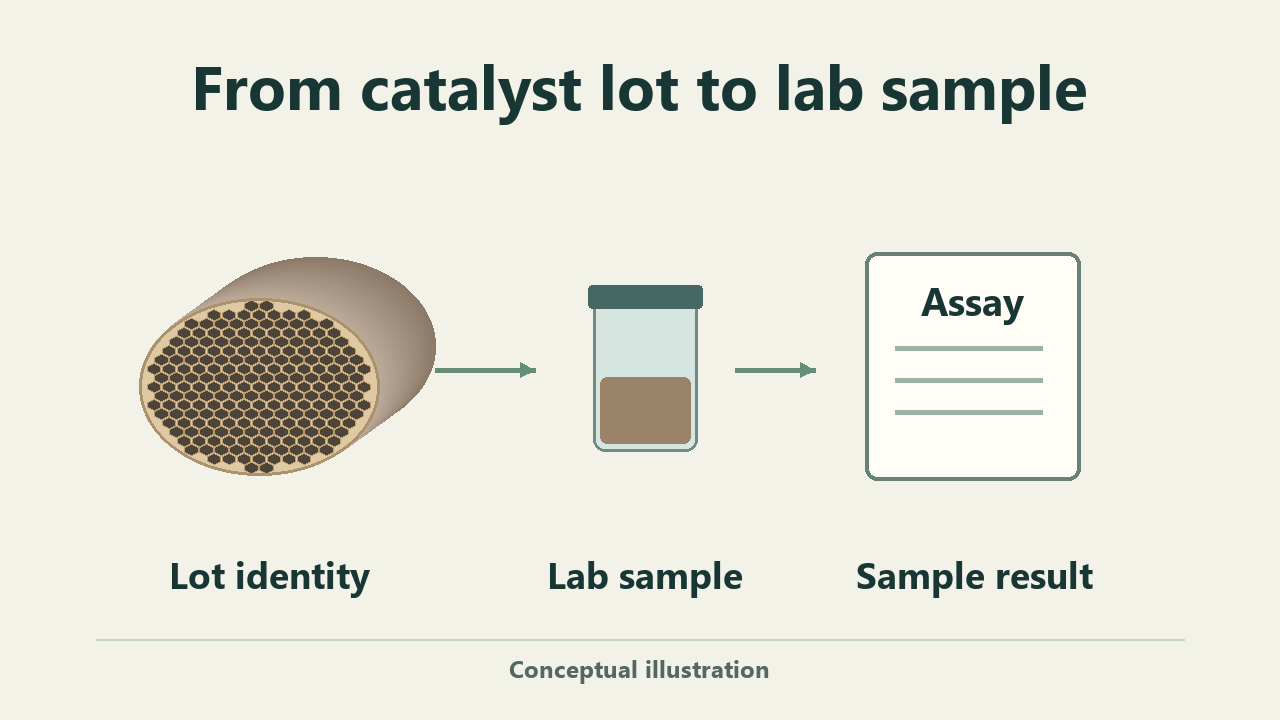
Match the certificate to the lot identifier, sampling date, material source and laboratory description. Automotive converter ceramic and petroleum refining catalyst are not interchangeable feedstocks. PolyGO’s spent catalyst application page identifies relevant material categories and carriers; it provides context for describing the feed, rather than proof of a particular lot’s composition.
Trace the sequence from consignment to collected increments, composite, prepared laboratory sample and analytical test portion. Were different containers, fines and larger pieces represented? What was combined, milled, mixed and subdivided? Request the record and rationale from the responsible sampler. A precise measurement of a convenient handful cannot establish the average grade of every drum.
Read individual metals before the total
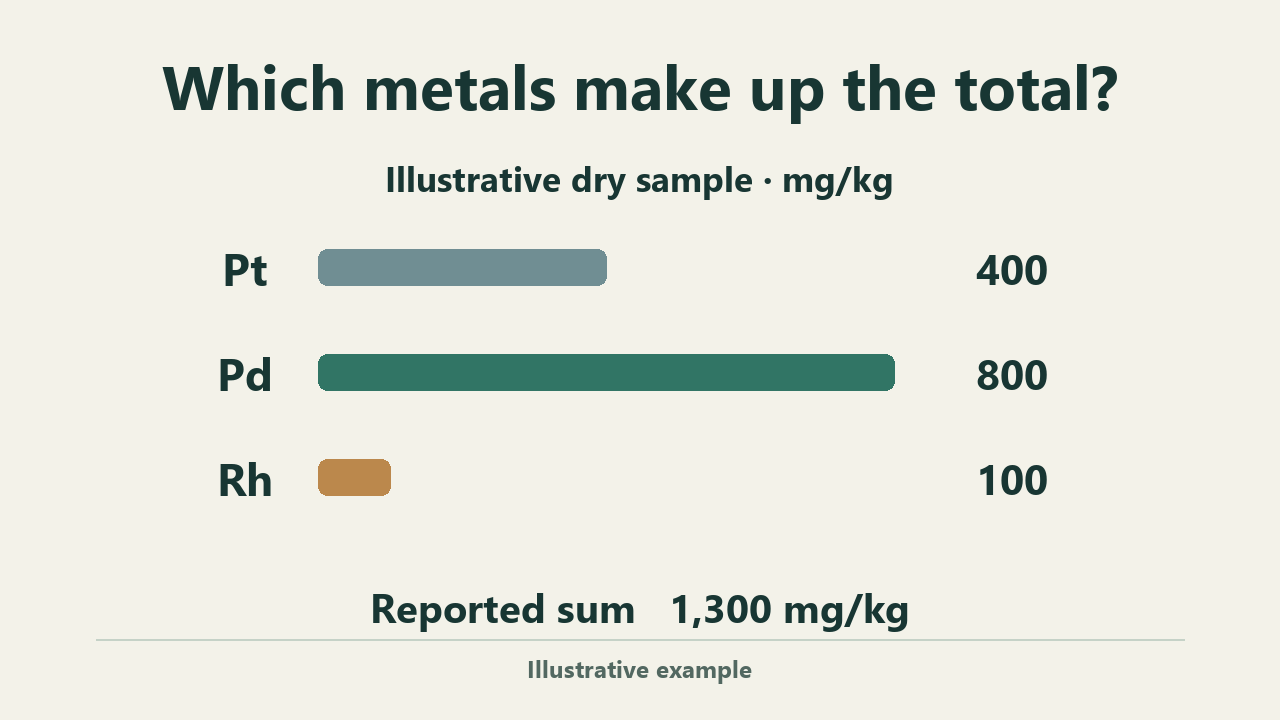
All example numbers below are hypothetical, chosen for arithmetic. They are not typical catalyst grades, PolyGO measurements or customer estimates. The main example uses one dry-mass basis throughout.
| Reported entry | Result |
|---|---|
| Platinum, Pt | 400 mg/kg |
| Palladium, Pd | 800 mg/kg |
| Rhodium, Rh | 100 mg/kg |
| Sum of Pt, Pd and Rh | 1,300 mg/kg |
| Iridium and ruthenium | Not reported |
The sum does not mean 1,300 mg/kg of palladium. It also does not establish the absence of other PGMs: iridium, ruthenium and osmium are not accounted for by adding Pt, Pd and Rh. Ask which elements were actually measured, rather than treating “total PGM” as a universal analytical definition.
“Not reported” differs from “below the reporting limit”. Preserve any less-than sign and ask whether the stated limit applies to the original solid after preparation and dilution. An instrument detection limit in solution is not automatically the reporting limit for catalyst powder. Do not silently replace a qualified result with zero.
Match concentration to the correct weight
For solid mass fractions, 1 mg/kg equals 1 gram per metric tonne. Confirm that “ppm” means mg/kg; solution results in mg/L require a different calculation. Also establish whether the weighed material excludes containers, converter shells or other components absent from the assay sample.
In the main hypothetical example, 1,000 kg of dry material at 800 mg/kg contains an estimated 800 grams of palladium:
1,000 kg × 800 mg/kg ÷ 1,000 mg/g = 800 g Pd.
If a hypothetical 1,000 kg net shipment instead contains 10% moisture by mass, dry mass is 900 kg. Multiplying that mass by the same dry-basis grade gives 720 grams of palladium. Check that moisture represents the same material and that its measurement conditions are stated. Neither calculation predicts recovered output.
Look beyond the instrument name
XRF measures a prepared solid without requiring dissolution, but calibration, matrix effects, particle size and sample presentation matter. ICP-OES measures elements in a prepared solution; it cannot establish that decomposition transferred every target metal from the original solid into that solution. Ask whether the reported result represents total content or an operationally defined extraction.
A directly relevant analytical study is Accurate Determination of Platinum and Rhodium in Spent Automotive Catalyst via Copper Fire Assay Method for Resource Sustainability, published in ACS Sustainable Resource Management in 2024, DOI 10.1021/acssusresmgt.4c00349. It investigated copper fire-assay collection followed by ICP-OES, identifying sample heterogeneity and matrix interference as analytical challenges. Its validation concerns that method and tested materials, not every procedure bearing the ICP label.
Request preparation details and quality-control evidence appropriate to the decision. A preparation duplicate examines more of the analytical chain than repeat readings of one solution. A method blank checks contamination; a suitable certified reference material checks agreement with an assigned value. A spike added after digestion cannot prove that original metal trapped in an undissolved carrier was recovered. Ask what uncertainty includes, especially whether sampling uncertainty is excluded.
Correct an unequal comparison
Consider a separate hypothetical comparison between automotive catalyst lots offered at the same dry mass. Report A states “total PGM: 1,300 mg/kg”, without defining its elements or moisture basis. Report B states Pd at 700 mg/kg dry basis, with Pt and Rh separately identified and a documented sampling basis.
Choosing A because 1,300 exceeds 700 compares an undefined combined concentration with one element. A’s palladium grade remains unknown; B’s palladium inventory can be estimated if its sampling and dry weight are adequate. Obtain A’s element breakdown and matching basis before comparing palladium inventories. Report B’s 700 mg/kg belongs only to this separate example.
Separate assay, dissolution and collected product
Nguyen, Riaño and colleagues’ Solvometallurgical Recovery of Platinum Group Metals from Spent Automotive Catalysts, ACS Sustainable Chemistry & Engineering (2021), distinguishes starting-material characterisation from subsequent separation experiments. The researchers used microwave digestion and ICP-OES for quantitative catalyst characterisation, with triplicate preparation. Their experimental leaching behaviour differed among Pd, Pt and Rh and changed with solvent and oxidant conditions.
The decision-useful lesson is that feed concentration and extraction are separate measurements. Triplicate characterisation of prepared powder does not establish representativeness of an unrelated commercial consignment. Dissolving a metal does not establish its collection in a saleable product, and results for automotive catalyst do not validate petroleum catalyst treatment.
For a recovery estimate, request a same-run metal balance covering feed, product, liquid streams and remaining solids, with unexplained differences visible. PolyGO’s PGM recovery chemistry page distinguishes stripping and leaching routes. Use it to frame route-specific questions after identifying the actual target metal and carrier.
Choose the next test from the missing evidence
If identity is uncertain, resolve the certificate-to-lot link. If sampling is uncertain, address collection and preparation before commissioning a more sensitive finish. If an element, reporting basis or limit is missing, ask for clarification or suitable additional analysis. If composition is adequately established, a feedstock-specific trial can address recovery questions.
PolyGO’s Waste Evaluation service describes characterisation and bench-scale assessment. Ask which measurement would resolve the specific remaining uncertainty, keeping its result separate from the incoming assay.
Short FAQ
Can two laboratories disagree without either making a calculation error?
Yes. Different test portions, preparation, decomposition or interference correction can produce disagreement. Investigate those differences before averaging results.
Should a blank ruthenium field enter the spreadsheet as zero?
No. Record it as unreported and establish whether ruthenium was tested.
Can a dry-basis grade be multiplied by gross delivery weight?
Only after removing packaging and other excluded mass and correcting moisture to match the assay basis.